Each entry opens with the product itself: a demo, a capture or real output. AI agents wrote most of the code under my direction.
Alderline Agent
Field
Applied AI
Role
Founder, operator, product owner
Status
Private / in use
Built by
AI agents under my direction
Org
Alderline Systems
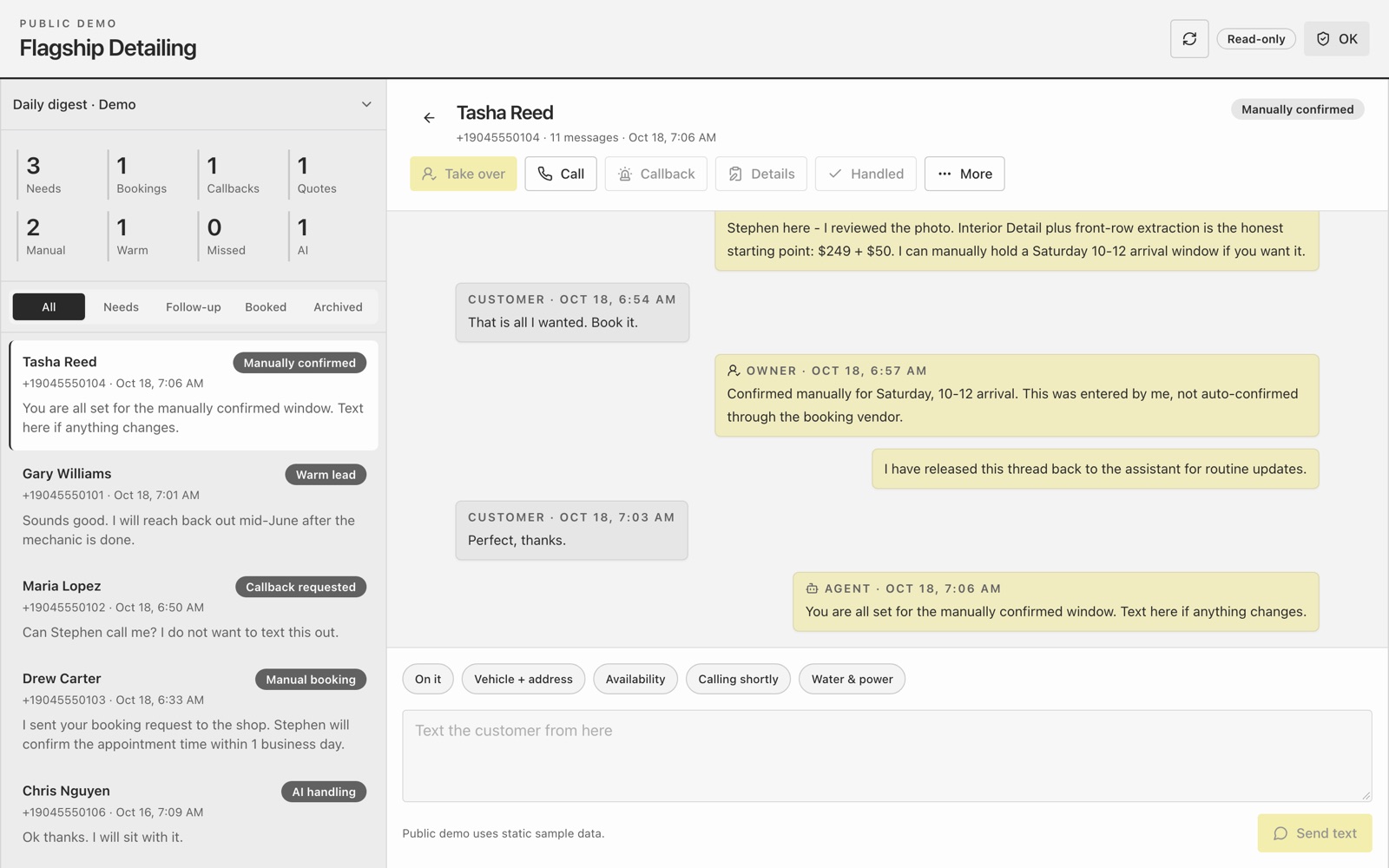
The owner dashboard's public demo, with sample data. Open the demo
A customer calls while I'm in the middle of a detail. A lead needs a reply. A booking needs confirming. That's the job this software has to do.
Flagship Detailing, the business I run, is where the requirements come from. Alderline Agent connects inbound texts and calls, AI-assisted replies, scheduling, human takeover and an owner-confirmed record of what actually happened, rather than a model's guess.
The hard rules in it are mine: how much notice a booking needs, which services are quote-only, when to hand a conversation back to a person. The agents enforce them; I wrote them down from running the business.
Directing, building and testing the Android client
Status
In testing on Google Play
Created by
Kun Chen, who maintains the iOS app
Merged
26 Android pull requests
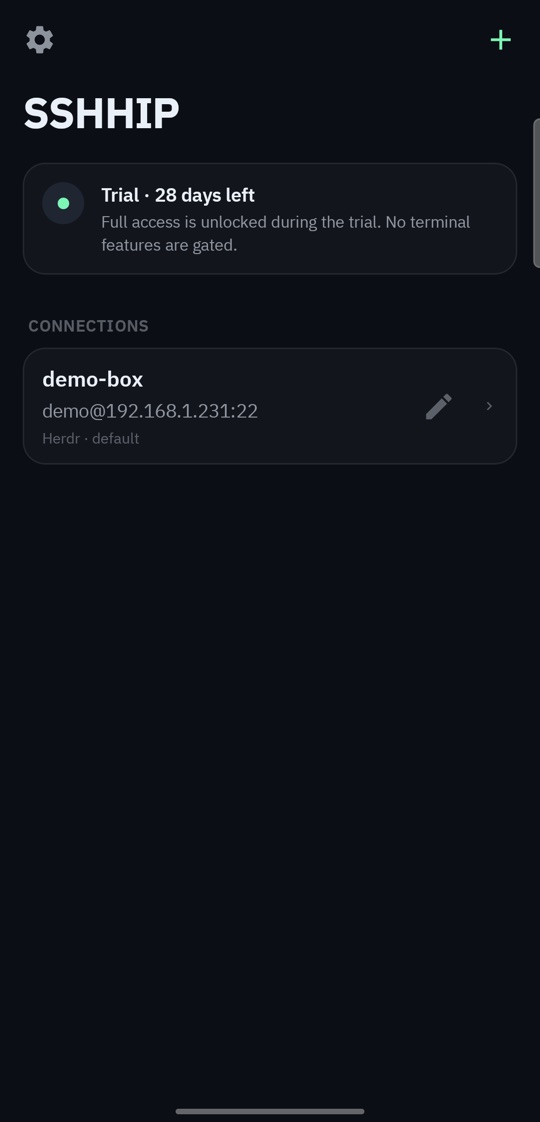
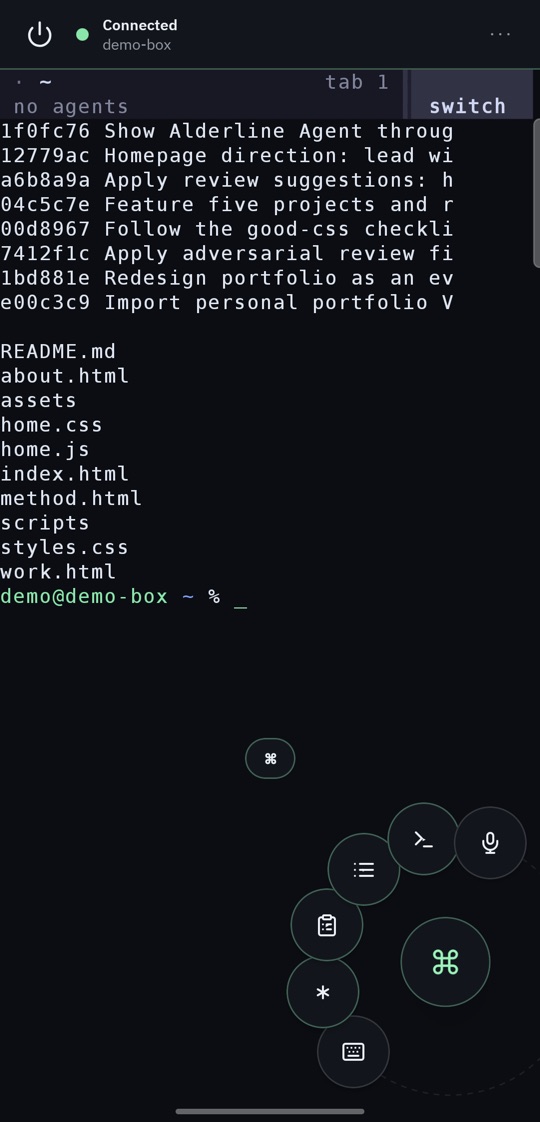
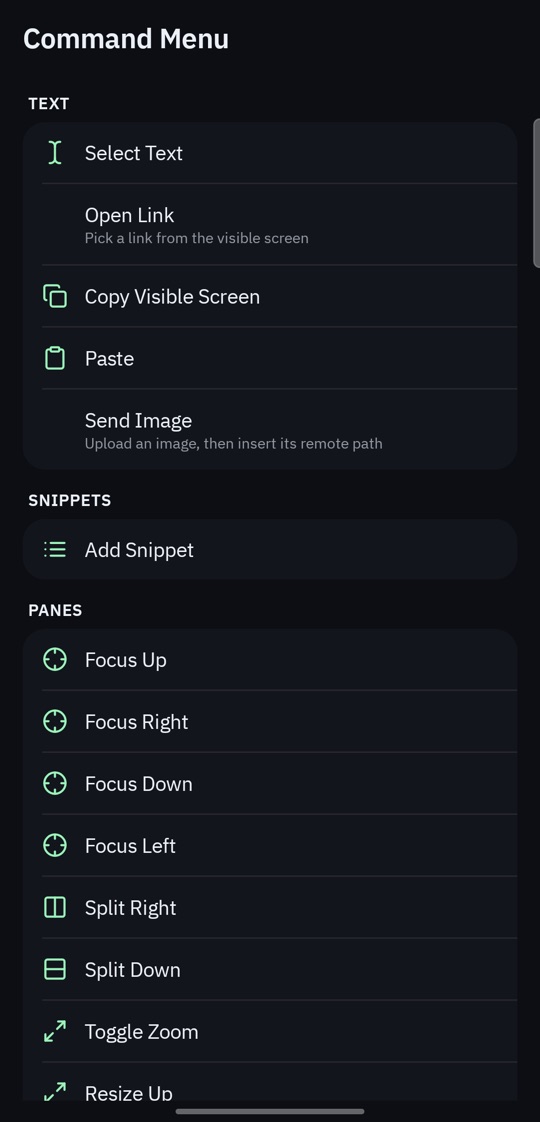
A debug build on my phone, connected to a demo account. Some of what's shown is still in review.
SSHHIP reaches your own machines' terminals from a phone. I'm building its Android version.
This is the largest piece of work I've taken on in someone else's product. I direct and test it, AI agents do most of the implementation, and Kun reviews and merges. The Android app isn't a port of the iOS code: both are built to the same written description of how SSHHIP should behave, so a machine behaves the same from either phone.
Merged so far: the first build, host connections and SSH, the Command Dial, the native interface, a live Agent Map, terminal themes and font size, and the app icon. Since then: session reliability and reconnect fixes, Android 16 support, notifications, a password fallback for sign-ins, and Google Play billing for a lifetime unlock.
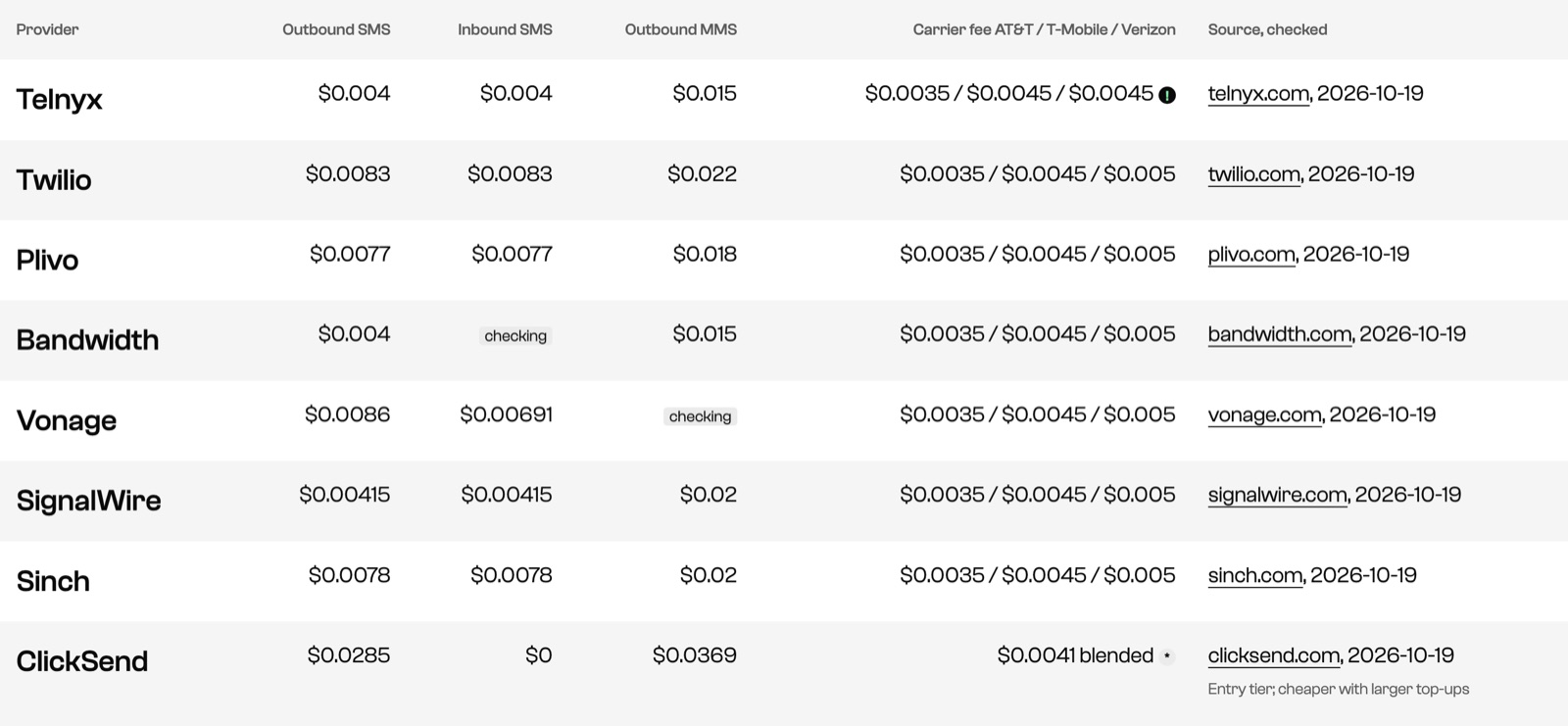
The live price table. Two cells read "checking" because their sources couldn't be read that day.
What does a US text message actually cost? The answer is scattered across providers' pricing pages and carriers' fee tables.
TextStack is a standalone site, separate from Alderline Systems. It tracks SMS API list prices for eight providers, carrier pass-through fees and 10DLC registration fees (the sign-up US carriers require before a business can text from an ordinary phone number), with plain-English fixes for common campaign rejections and a free campaign checker. Every price links to the provider's own page with the date it was last checked.
A scheduled job re-reads the sources every day. A big price change, a page it can't parse or a disagreement with the provider's own help article becomes an alert for me to review, not an automatic update. If a number can't be read from the source, the site says "checking". It never estimates.
The v0.1.0 example: naive delegation lets a child agent widen its authority; the GCO runtime refuses.
When an agent hands work to another agent, how do you keep the child from gaining authority the original task never had?
GCO is a public reference implementation in Python: attested context, parent-to-child authority limits, runtime decisions, state namespaces and an evidence trail across recursive agent workflows. A host application applies its checks to its own tool calls and state. The accompanying position paper lives in the repository.
Before releasing it, I had the paper re-checked, cut a section that overreached, decided against an arXiv submission and tagged v0.1.0 on GitHub rather than inventing a package release.
$ npx @ssbrouhard/packsift lodash@4.17.20 lodash@4.17.21
packsift  lodash@4.17.20 -> 4.17.21

-- Flagged ------------------------------
  No notable supply-chain signals.

-- Files --------------------------------
  added    5
  removed  0
  changed  12

  C  README.md                    (+2 / -2)
  A  _baseTrim.js                 (new, 0 -> 444 B)
  A  _trimmedEndIndex.js          (new, 0 -> 515 B)
  C  core.js                      (+1 / -1)
  C  core.min.js                  (+24 / -25)
  A  flake.lock                   (new, 0 -> 963 B)
  A  flake.nix                    (new, 0 -> 459 B)
  C  lodash.js                    (changed, binary/large, 530 KB -> 531 KB)
  C  lodash.min.js                (+126 / -125)
  C  package.json                 (+1 / -1)
  C  parseInt.js                  (+1 / -1)
  A  release.md                   (new, 0 -> 2 KB)
  C  template.js                  (+21 / -0)
  C  toNumber.js                  (+3 / -5)
  C  trim.js                      (+2 / -4)
  C  trimEnd.js                   (+3 / -5)
  C  trimStart.js                 (+1 / -1)
PackSift 0.2.1 comparing two lodash releases.
Your Git diff isn't necessarily the npm package someone installs.
PackSift compares published or locally packed npm artifacts: files, install scripts, native binaries, hashes and drift. It reports reproducible facts instead of handing down a safe or unsafe verdict.
The philosophy is simple: show the evidence clearly and let a person make the consequential call.
Each of these adds something different. More experiments are on my GitHub.
Helm Private / in development
A desktop app for steering coding agents. A local service keeps goals, decisions, event history and terminal sessions; the window is only a client, and it can connect to an existing Firstmate setup. It isn't released, and it labels rules that nothing enforces yet as "not enforceable yet".
Vesta Mail Governance Adapter Production-alpha
A control plane between an AI agent and a mailbox: action proposals, policy decisions, approvals bound to the exact action and an evidence log. Real isolation still depends on the host keeping credentials and the write path out of the agent's reach.
Builds an evidence pack about legacy Python before anyone rewrites it: structure, history, candidate invariants and characterization runs. When it can't run something, it says so. The public repository is new.
Two small command-line tools built on Kun Chen's AXI design for agent-friendly interfaces: read-only SQLite inspection, and npm registry search, with compact output an agent can use cheaply.
The sites for Flagship Detailing and Alderline Systems, including service pages, lead and audit forms and automated deployment, built by AI agents to my brief.
An ambitious AI-safety design looked convincing on paper, so I asked for one small, fair experiment before anyone built it big. It tied a simpler, separate classifier. I published it with that result in the repository's description: no safety advantage established.
Forty-one merged pull requests across six repositories I don't own, including the SSHHIP Android pull requests above. The maintainers reviewed and accepted them; the projects remain their creators' work.
AI agents implemented much of this under my direction. What I contributed was scope, a quality check before submitting, and follow-through on what the maintainer asked for.
7
Firstmate Kun Chen
Orca backend support: primitives, task lifecycle, tighter parsing, an adapter contract and an operator skill. Plus Codex backend docs and a coordination skill. These landed in Firstmate, not in the Orca app itself. The lesson I kept: mocked tests didn't prove real backend support; real-binary checks did.